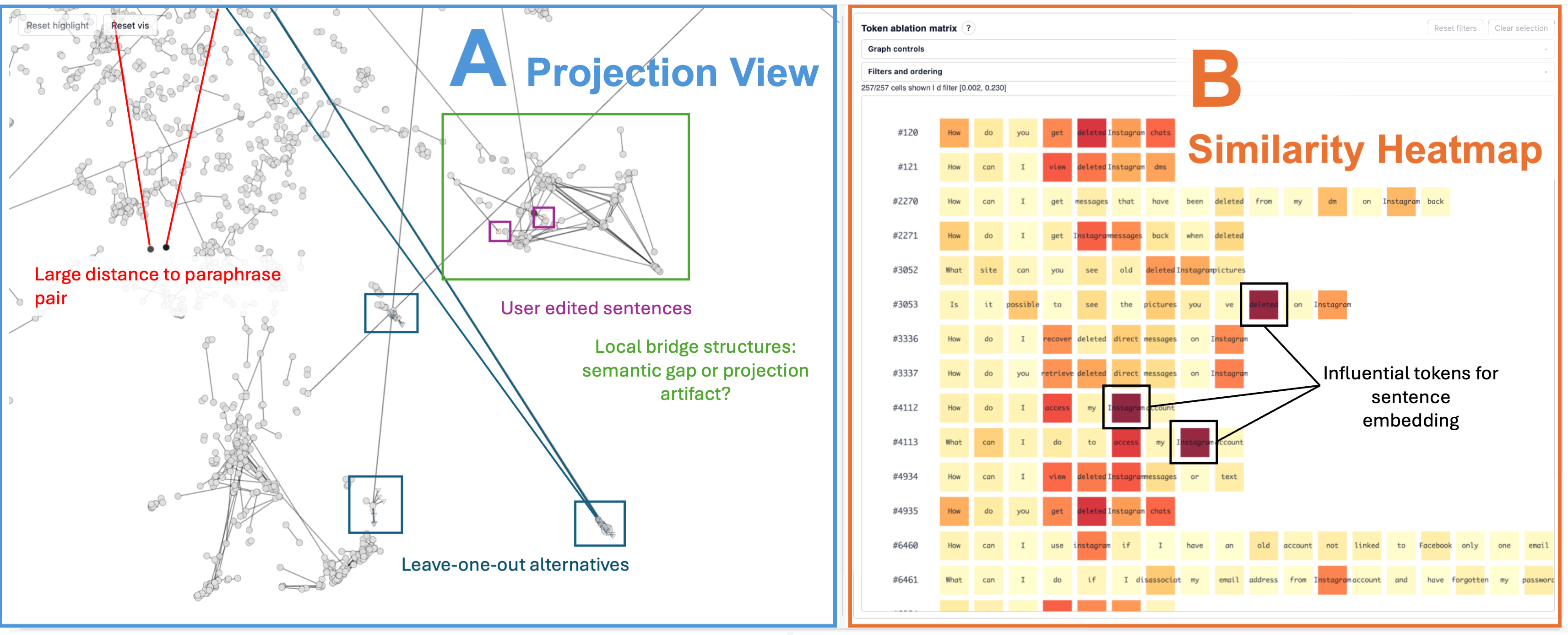
Abstract: Sentence embeddings are widely used as a proxy for semantic similarity in applications such as passage retrieval for question answering. A common approach to inspect such embeddings is to project them into a lower dimension. However, neither small embedding distance nor proximity in a low-dimensional projection guarantees semantic equivalence. We present an interactive analysis tool for exploring this mismatch on paraphrase pairs from the Quora Question Pairs dataset. The system combines an interactive UMAP projection, editable sentence variants, and a heatmap for token sensitivity analysis. This enables users to inspect whether local neighborhoods in the projection reflect relationships in the original embedding space and to identify tokens influencing the sentence representation. In a qualitative case study, we show failure modes, including paraphrase pairs with unexpectedly large embedding distances and non-equivalent questions in which local neighborhoods are not defined by semantic similarity. Our results show that visual proximity should be treated as an exploratory cue rather than a semantic equivalence.
@inproceedings{Schmidt2026Paraphrase,
  author    = {Schmidt, Manuel and Keim, Daniel A. and Dennig, Frederik L.},
  editor    = {Archambault, Daniel and Nabney, Ian and Peltonen, Jaakko},
  title     = {{Visual Analysis of Semantic Paraphrase Embedding Projection Stability}},
  booktitle = {Machine Learning Methods in Visualisation for Big Data ({MLVis})},
  publisher = {The Eurographics Association},
  year      = {2026},
  doi       = {10.2312/mlvis20261002},
  url       = {https://diglib.eg.org/handle/10.2312/mlvis20261002}
}